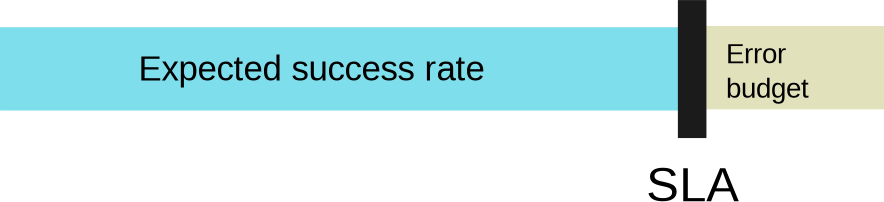
Now we focus on the previous example of the unavailability budget of 1%.
If 2% or worse, 3% of unavailability occurs on production, this would mean the SLA is not respected.
Consequences could be either a loss of reputation or financial penalties.
Therefore not using more than the error budget is really important.
But how can we guarantee it ?
If downtimes are observed, we need to be broad-sighted enough to understand if these are threatening the SLA
or if they are small enough to be ignored.
There is a method for this.
For instance, on a 24h period of time, if our website receives 10 000 requests, it is allowed to
be unavailable 100 times. This means 4 times in one hour. If we observe 4 errors on one hour,
or less than 4 this is fine. But if there are 8 errors per hour, at the end of the day, there would be
192, which is almost twice the error budget.
The following graph shows these situations.
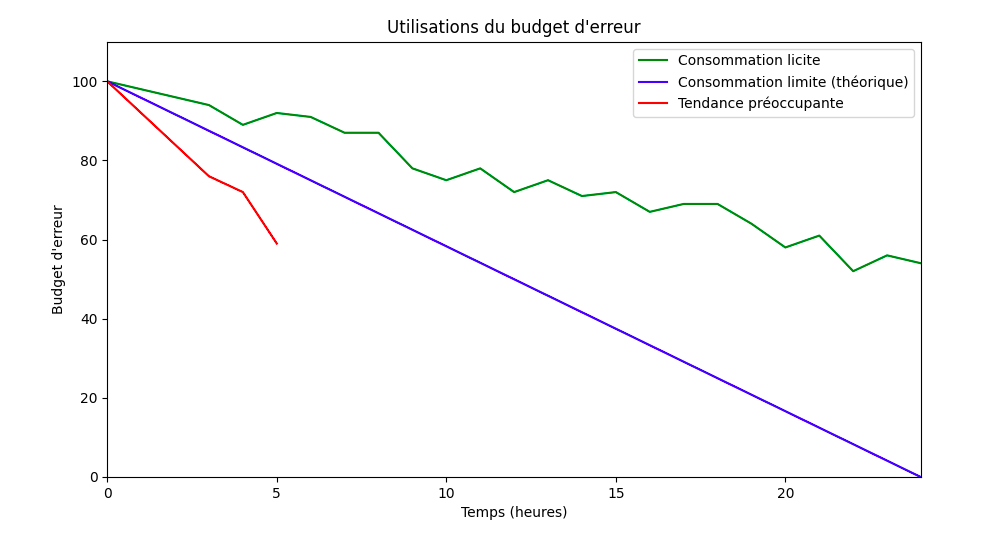
The first curve (in green) shows an acceptable error budget consumption.
It is slower than the theoretical limit situation (in blue).
But the last one (in red) presents a situation that has a problematic tendency.
Reacting in this situation with a real-time analysis is a reasonable behavior.
Alerting based on the
error budget fast burn rate is a good practice.